
Changing Currents of Sumpango – Written by Erin Quinn
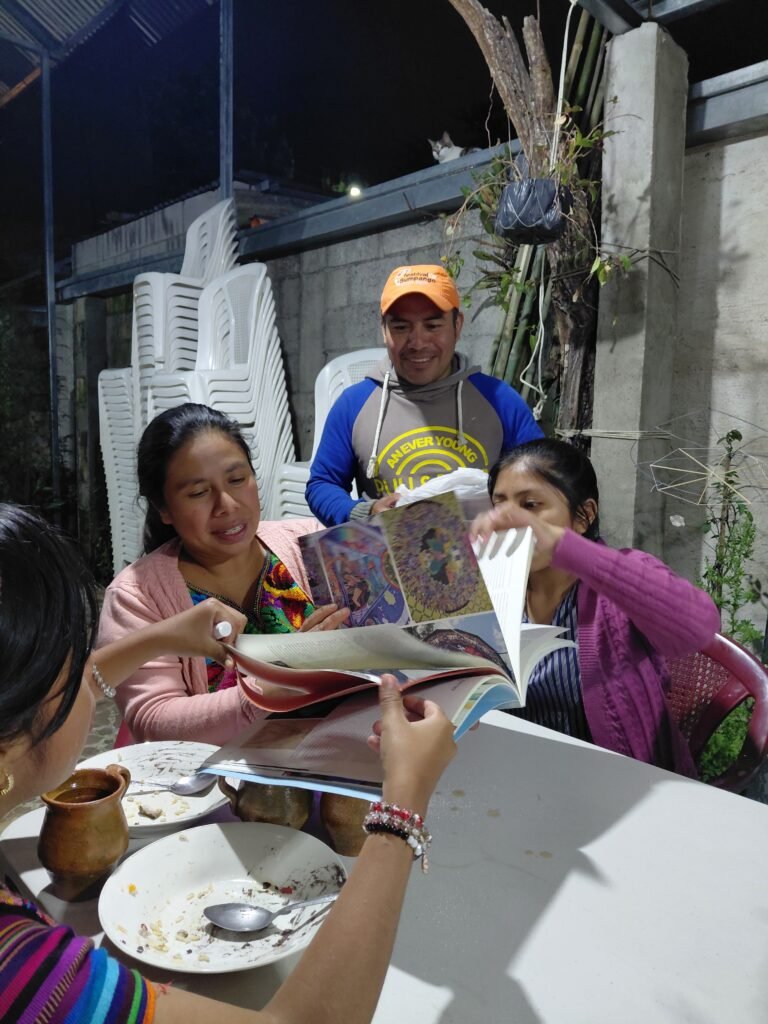
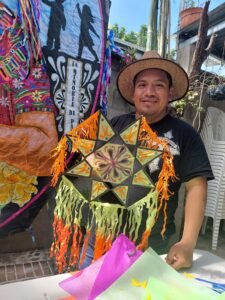
The first thing I noticed waking up in the mountain town, surrounded by volcanos, was the truck horns. They didn’t just honk, they blasted a mariachi prelude, the brakes took up the bass, birds filled in the melody and it ended just as suddenly as it began. I had come to Guatemala for the Festival of the Barriletes Gigantes and I was already feeling a little of the magic. I first became aware of the festival through the archives of Drachen Kite,which contains a rich trove of kite history and culture from around the world. Just exploring their archives is a fabulous kiting journey. Logistical planning for the trip was a challenge as I discovered that Sumpango did not have any tourism infrastructure, no hotels, no restaurants and limited public transportation. I posted a inquiry on the Kitebuilders FaceBook page and received a response from Florentín Sulá Sulá, a local kite artist, welcoming me to visit! Over several months we communicated via Whats App to arrange lodging at his family home and a local driver.
A week before my departure I received a mysterious gift. The book,
Wings of Resistance: The Giant Kites of Guatemala, appeared as if by magic on my doorstep. It is an exquisitely written and deeply researched work about the origins and cultural significance of the giant kites created for the festival, which is held each November 1. I had seen the incredible photos of the giant colorful kites and knew that they had a role in honoring the ancestors, as is the custom throughout Latin America during the holy days surrounding “The Day of the Dead”, however I had no idea of the social and political importance of the kites for the indigenous people of the area. The book traces the direct line from the ancient Aztecs, who described decorative tethered paper, which had a ceremonial role in communicating with the spirits, to the contemporary indigenous Mayan people of Sumpango and nearby Santiago Sacatepéquez, who use the giant kites as an art form to express not only pride in their culture, but also to tell their story in their own way, despite centuries of domination by the colonial class.
Despite my protests Florentín had insisted on accompanying the driver to meet my sister, Janet and I at the airport in Guatemala City. I could have hired a driver from the city, but it was my intention to support the village of Sumpango as much as I could during my stay. At the airport we watched the sweet reunions of families, the women in multicolored, woven traditional dress, with infants bound to their backs, greeting their returning travelers. Florentín, a quiet, serious man of uncommon warmth, introduced us to Alfonso, our driver, and we set out on the rough road to Antigua. Our carriage was an old minivan with a broken wind shield, bad shocks and no seatbelts. During the hour-long ride I shared the book with them, we talked about its perspective, how it honored the kites as their method of storytelling, addressing issues of social injustice through art. They nodded in agreement, appreciating the significance of the title. Florentín, sitting shotgun, opened the first page, showed Alfonso the photograph and said, “That’s one of ours”.
Our guides didn’t leave us until we were safe and settled in our hotel in Antigua. We were already feeling taken care of.
Alfonso returned a couple days later to take us to Casa Palot, Florentín’s house in Sumpango, where we would stay for three nights. As the old minivan ascended into the rugged mountains he told us about the feverish pitch of preparations for the festival. Everyone in town was working around the clock, first at their day jobs, then either building kites at night or like himself, hiking into the forest with teams to cut tall pines for the structures that support the kites on the day of the festival. The teams worked in semi-secrecy wanting to protect their territory as competing teams were also searching for trees. They worked through the nights, finding and cutting the perfect trees and then hiking out of the mountain forest carrying the logs collectively on their shoulders.
Near the entrance of Sumpango we met Florentín who helped us carry our luggage up the steep rubble road which led to Casa Palot. At the top of the hill we passed through a narrow alleyway decorated with garlands of delicately cut tissue paper dancing in the breeze. As we approached the house I remembered a conversation I had had with Nic O’neill, from Fortuna Found, who had lodged there previously. She had had a wonderful experience, and had cautioned me about the very basic accommodations; “cinder block walls, cold shower”. When we reached a large metal door with a stained glass window Florentín stopped in front of it. He looked exhausted. He gave a very solemn speech about the humbleness of his home, tempering any expectations, he told us it was a shared home with four families, all brothers and sisters, and how honored he was to host us. I thought “I’ve slept rough before, I can handle anything for three nights.”
When he opened the door it was as if angels were singing atop silver lined clouds with the sun bursting through. It was clearly the home of an artist. Every surface was adorned, birds were singing, music was playing, beautiful handmade kites were suspended from the ceiling and displayed on the walls. The interior courtyard was lush with plants and small fountains, crafted from clay water jugs that the brothers had used as children to haul water from the town well. At the far end of the courtyard was an altar. The entire wall was covered with golden marigolds, photographs of the ancestors were surrounded by candles. It was a special shrine to honor the one year anniversary of the death of his father.
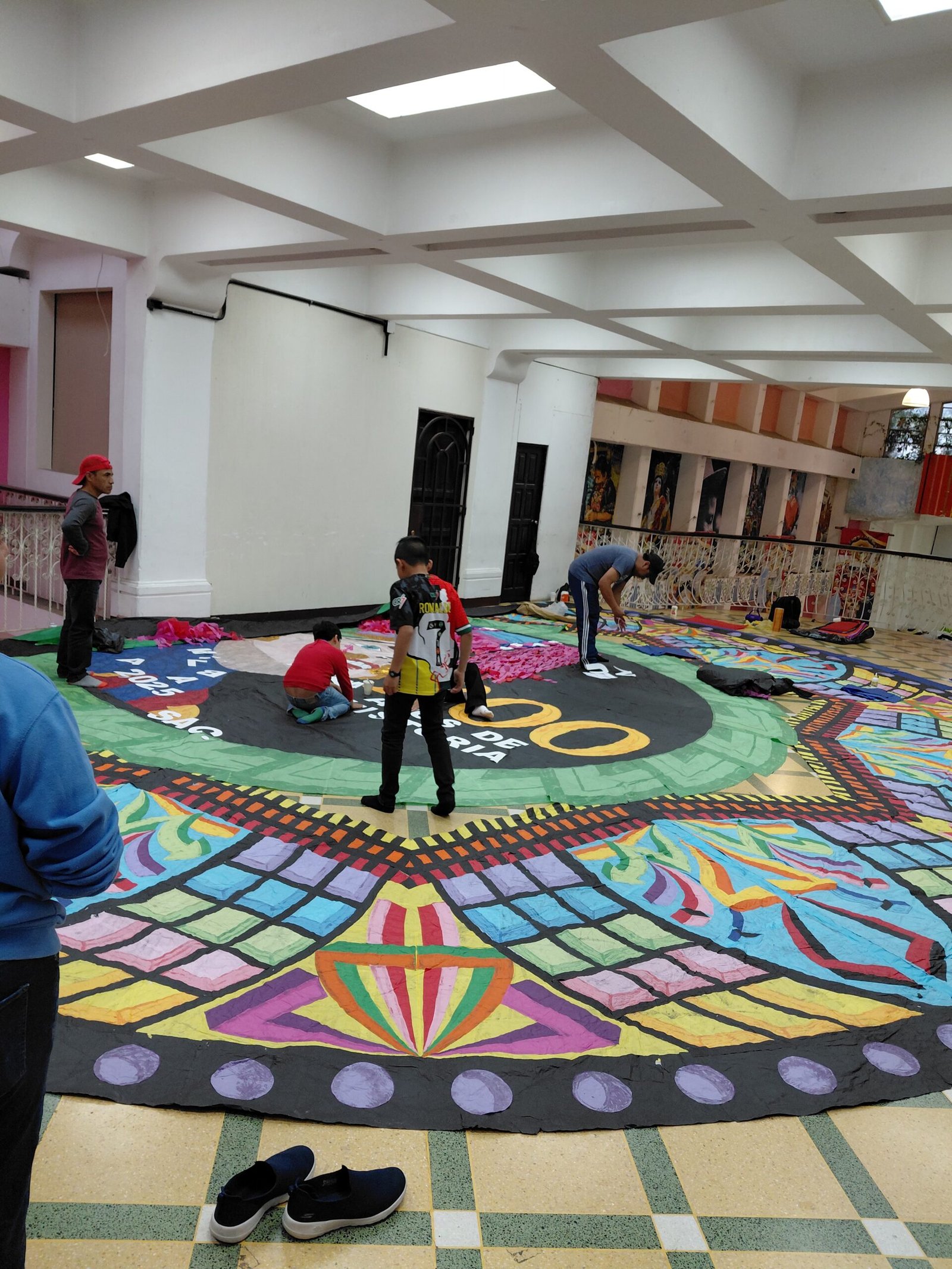
The entire household was bustling with preparations for the biggest day of the year. Stacks of tables and chairs, and new beds were being carried to the back of the house. They planned to receive additional house guests later that day, and the following morning, sixty travelers would arrive for breakfast on their way to the festival. Florentín had not slept for ten days and the kite still was not complete. He was clearly spent. October 31 is the traditional day to decorate the graves of relatives, to honor the dead and to recognize the continuity of life and death. Janet and I accompanied Viviana, Florentín’s wife and their daughters to the cemetery where we cleaned and decorated the family tombs. The cemetery was full of life, families lovingly painted bright colors on tombs while kids flew kites and mariachis ambled in the street. People who were not decorating graves were busy building kites. They occupied any available enclosed space large enough to accommodate them. Some groups are large community teams, some are small family teams, everyone is working with a common goal, but the teams are competing. We visited a large community center where Viviana respectfully gained permission for us to enter and observe the fabrication, which had been going on for weeks, and was now up against the deadline. Dozens of people, mostly teenagers in stocking feet, were working intensely, gluing layers and layers of colored tissue paper, to create a graphic design, resulting in a fairly strong kite face made from very delicate paper. The kites occupied both levels of the center, each level the size of a basketball court.
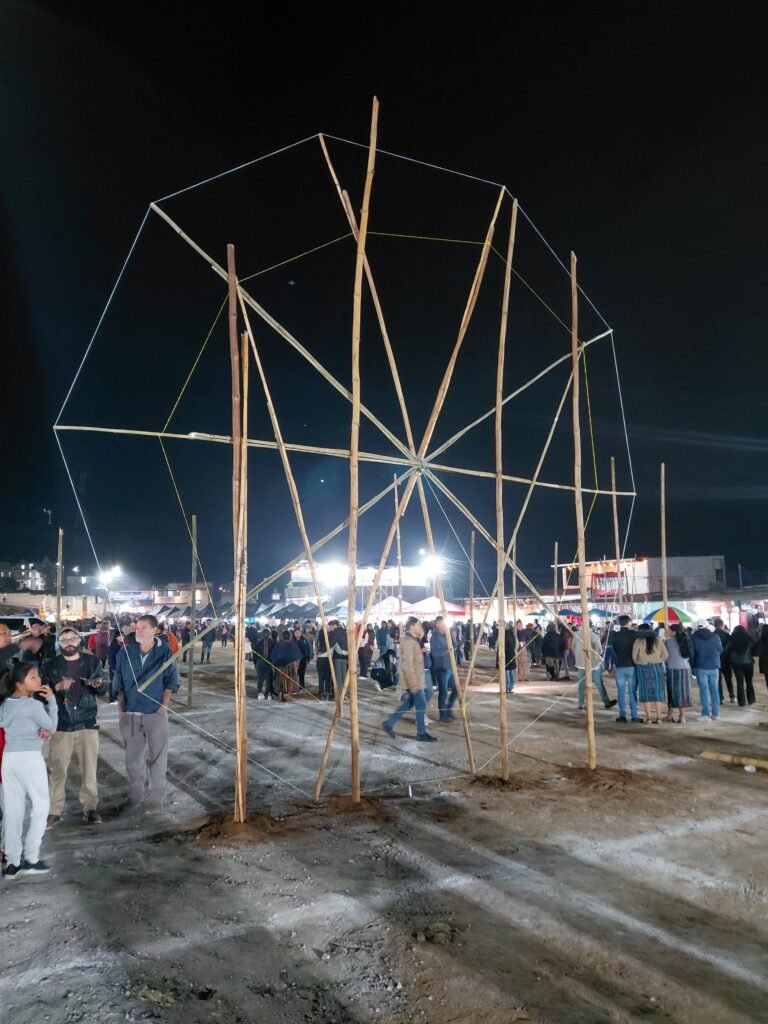
Later that evening the new guests arrived to Casa Palot and after a shared supper we accompanied Victor, Florentín’s brother and his son up to the field where the festival is held, where preparations were underway. The two of them shared the weight of a long bamboo pole on their shoulders, climbing the steep streets, as the house guests, all women, walked along in single file avoiding traffic and pitfalls in the road. When we arrived at the field someone with a camera teasingly told us to help the guys carry the pole. We put it on our shoulders to pose for a picture, as if we had carried it, and the men, exhausted, stepped away. It was shockingly heavy! Victor set to work digging a deep hole to set the bamboo pole upright. The field was full of teams setting up support structures, the largest ones with pulleys systems and and heavy ropes. Victor warned us seriously, “ Pay attention, accidents happen”. The party with live bands, dancing, food and drinks to accompany people preparing for the festival was underway when we left the field around midnight.
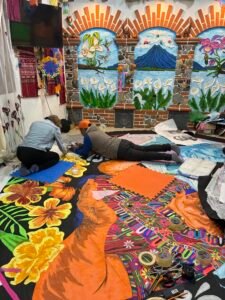
Back at Casa Palot the extended family was working in spontaneous shifts on different sections of their kite, which was spread out on the tile kitchen floor. Food cooked on the stove, the baby and the chihuahua wandered in and out, looking for an available lap to sleep in, cups of hot chocolate were passed around, marimba music always playing in the background. The artwork, depicting Florentín’s mother on earth communing with his father in heaven, was incredibly detailed and only revealed in small sections on the kitchen floor. The design came to life with the meticulous cutting and gluing of small pieces of tissue paper, the shading created by layering the different colors was sublime.
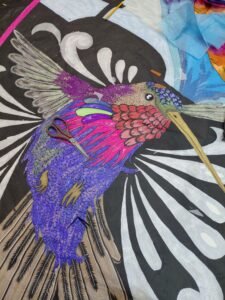
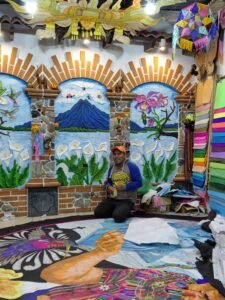
I could see a difference in the details of this kite compared to the ones we had seen earlier at the community center. The giant kites at the community center had more graphic, less illustrated design, the kites were much larger, with less detail, the depth of color and shading, not as complex. The artists of Sumpango are having the same conflict as artists the world over. Many of them are embracing digital artwork and AI design. Florentín made it clear he was having none of that! Janet and I took our spots on the floor, carefully cutting and pasting, under Florentín’s supervision, watching design elements come to life with just a subtle added shadow or outline.
When I couldn’t sit on the floor anymore I went to take the dreaded cold shower, but was delighted to find hot water. I knew from past experience the water heater was the type where you dare not reach above your head, because if you do, you will find live electrical current.
As I prepared for bed I regreted leaving the family working while I rested. I considered returning to the kitchen, but I heard their voices murmuring in quiet harmony and felt such a strong sense of their unity that I did not want to interrupt their flow. It was already hours into the next day.
I awoke early to voices in the corridor outside our room. There was a large animated group, the sixty breakfast guests had been on buses since 2 AM and were very excited to be near the end of their journey. They wanted to pose for selfies with me, morning face was not an excuse. I went to the kitchen to find my shoes, the kite was still on the floor unfinished. I heard a loud squawking and looked under the table. A brilliant green parrot claimed his territory atop my orange sneakers. He was not giving up his position without a fight. I made my way back to our room through the throng in the corridor, one of the travelers began to bang on the marimba in the hallway. I found my sister in bed with the pillow over her head, groaning. I laid down next to her and told her I would catch up with her later, I wanted to get to the campo early to see the kites faces being attached to their bamboo armatures, to see them being raised against the support structures and the sky. Just before I left Florentín knocked on the door, he looked absolutely drained, when I asked, he responded that he had slept a half hour, and about the kite, he just shook his head. He apologized for the chaos in the corridor. I told him I understood. It was as if he had to live his whole year in just this one day.
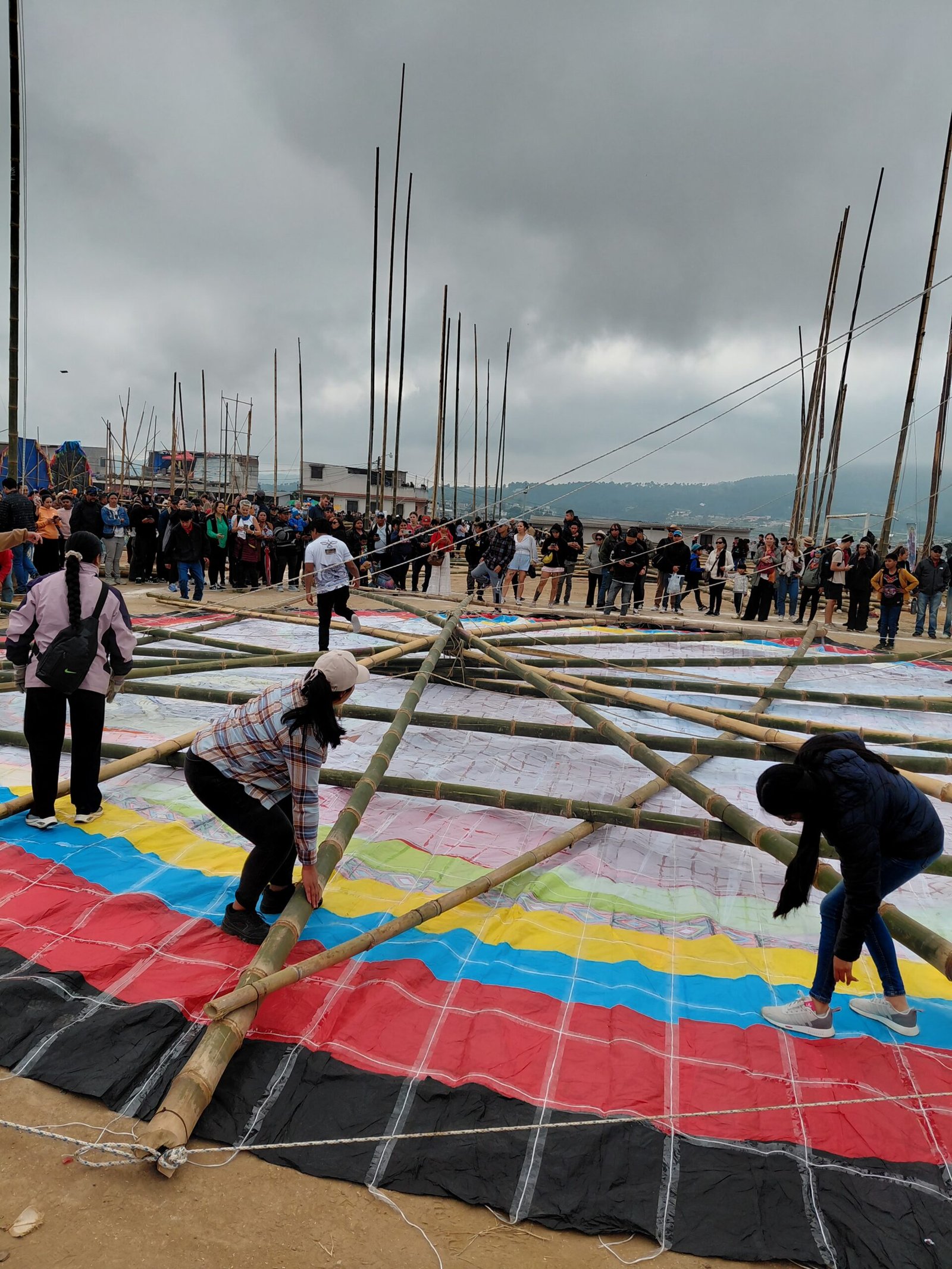
Things seemed to be moving slowly when I first arrived to the field, there were few kites standing against their supports. People were sleeping in their chairs, or just waking up from their long night. Within a short time there was a strong current of spectators entering the field. Kite teams were now diligently working, some kneeling on the ground gluing the edges of paper to bamboo and twine armature, some raising completed kites with block and tackle to the cheers of the crowd.
The field began to fill with upright kites arranged in rows, the smallest in the front, each row behind made up of progressively larger kites, and the giant kites, for display only, at the very rear. As more kites became upright and visible and the crowd became a swarm, the scale, the colors and the brilliance of the spectacle began to coalesce.
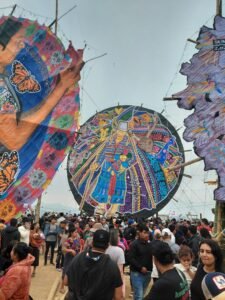
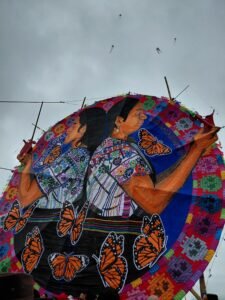
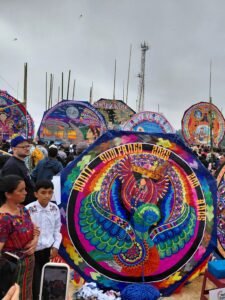
I met up with Janet and we watched the final preparations of a giant kite. A man repeatedly slid down a towering support pole as he tried to climb it to fix a pulley at the top. Someone brought a jumar, and encouraged by the crowd’s applause, was able to ascend and fix the line. The team on the ground finished attaching the kite to the armature. Now the moment every one was waiting for; the raising of the giant kite. Some team members took their place around the edges while others pulled heavy ropes in unison, with mechanical assist, at several fixed points on the kite. A large crowd stood watching breathlessly. When the leading edge was about 6 feet off the ground there was a loud CRACK and the kite came down, trapping some team members beneath it. There were so many people I didn’t know where to look, but I saw that one of the tall support poles, opposite where we were standing, had fractured. The crowd had quickly scattered, but now was forming again around a man not moving on the ground. An ambulance arrived quickly. The kite team got back to work and raised that huge kite up. Nearly all of the kites were standing now and the effect was magnificent, the colors radiant. Many designs were clearly inspired by the intricate weavings that have been passed down through generations. Most themes were family and community oriented, expressing pride in the history of indigenous art and culture.
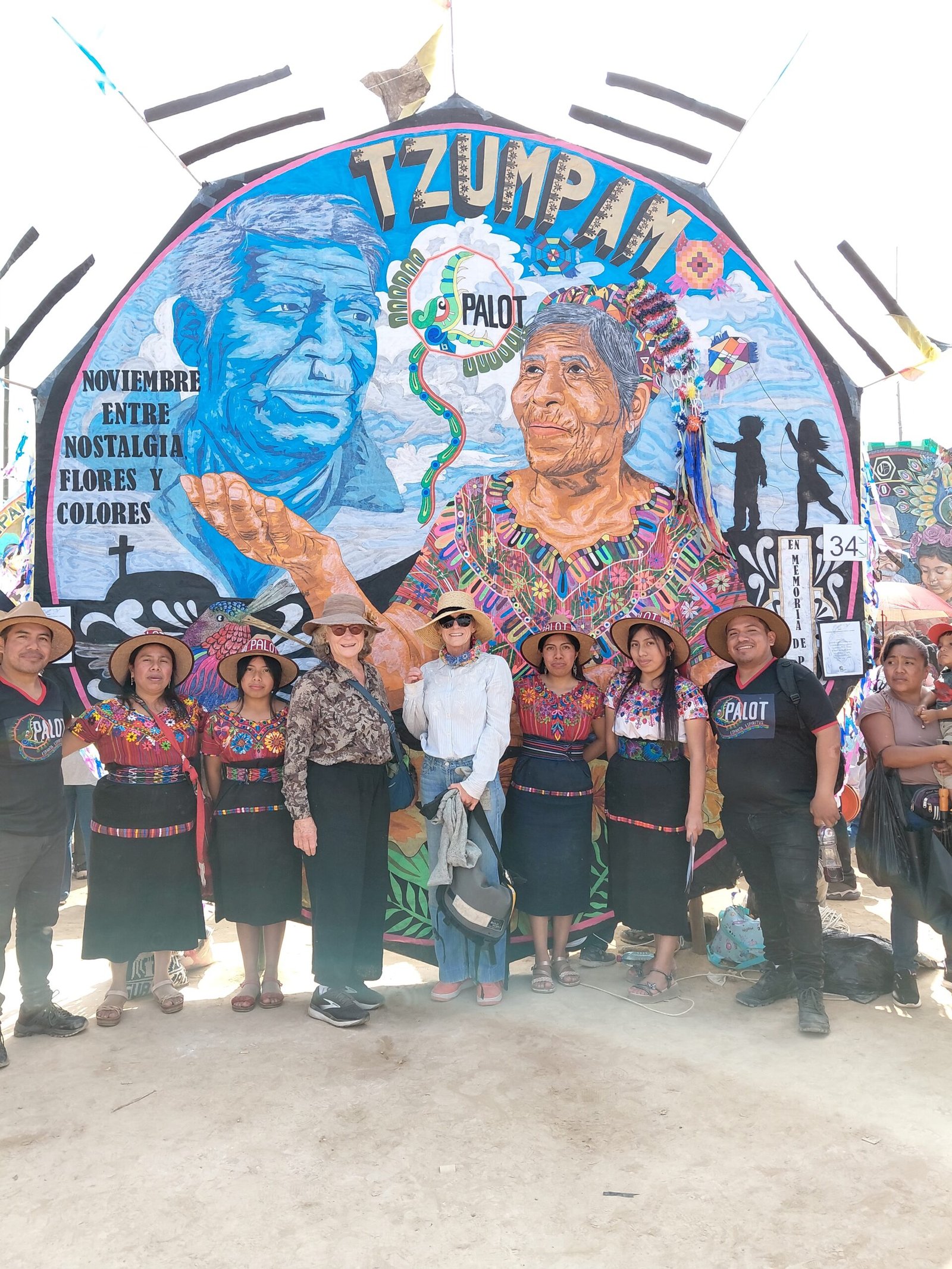
We were delighted to greet team Palot gathered in front of their kite. The morning sun illuminated the detailed artwork, bringing it to glorious life.
They had made their deadline, the kite was upright, in position and ready to launch. A long cordoned off strip was cleared through the crowd to provide space for a running launch for the heavy kites. Each team got two attempts. The mountain air was light and unstable near the ground, no one wanted to go first. After a brief delay team Palot volunteered to start. The family carried their kite to the end of the strip, Viviana and the girls in traditional dress, Florentín and Victor in jeans and t-shirts, all wearing their team Palot hats, with a woven hat band and decorative pom poms that display their ancestry through the art of weaving. They ran like fire with pom poms streaming, the kite became airborne, but was not able to reach the clean air away from the turbulence near the ground. Of all the kites that launched that day only a handful were able to soar. A number of them attained flight only to have the wind abate which sent the heavy kites careening down into the spectators, who scattered wildly. Some people did not run fast enough. Others, more attentive, gathered in a circle around the fallen kites and returned them, gently, back to their creators. A very loud speaker narrated events, always cautioning the crowd to pay attention, look sharp and be quick.
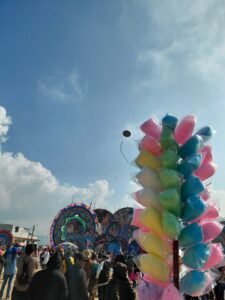
There were long lines for great food, a giant tub of blue corn masa was transformed into fresh tortillas one by one. Barbecue smoke wafted through the air accompanied by the smell of roasting corn on the cob. Little puffs of pink cotton candy floated above like small clouds. Ice cold Gallo beer was worth the wait. People from all over Guatemala and the rest of the world shared meals and stories at picnic tables in the shade.
In town, patios and garages had been converted into informal dining rooms for visitors. Janet and I were received with genuine warmth, hospitality and home cooked food in a pop-up diner. While we were eating we saw Florentín and his family carrying the heavy poles back down the steep hill towards home, collectively sharing the burden, Mayan style.
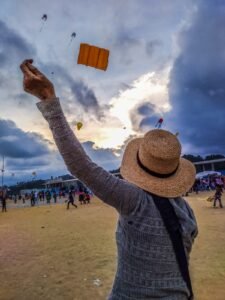
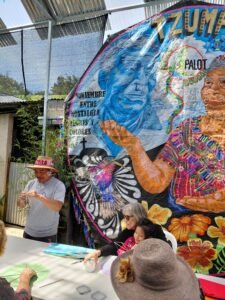
The day of the festival only people from Sumpango are allowed to fly kites in the field, but November 2nd everyone is encouraged to fly. That morning Florentín and Victor hosted a kite making workshop, patiently teaching traditional construction techniques, making sure everyone finished a kite to fly. Florentín had asked me to bring a kite from home, I chose a small, bright yellow para-foil. It was the first kite I had made because I didn’t know how to do framing. We took our new kites up to the campo, the wind was blowing from all directions, there were dust devils and a storm was building over the mountains. The yellow para-foil looked fabulous against the charcoal sky until it was hit by a huge gust, spun out of control and collapsed. Many people were curious about it, as they had not seen that style of kite before, and of course impressed that I had made it. Lightning flared against the dark sky over the mountains. I recalled a taboo against flying kites in a lightening storm and asked Florentín about it. He reassured me that the storm was far away, but considering he is someone who frequents an event where kites come crashing out of the sky onto spectators, I had to take his reassurance with a bit of reserve.
As darkness descended we walked with the family to the cemetery.
Florentín wanted to spend some time with his father, it had been a very emotional time, with the lack of sleep, being so busy with house guests and the festival, he had not had the opportunity to acknowledge the anniversary of his father’s death. The cemetery was vibrant, people were gathering with relatives both living and dead. It is believed during these holy days that the boundary between the the two is more permeable and families can be together joyfully. Families shared food and drink at the freshly decorated tombs while serenading mariachis roamed and the distant mountains glimmered in the storm.
The next morning Janet and I prepared to depart. I found Florentín in the kitchen building kites before breakfast for Janet to take to her grandchildren. We discussed kite tuning, reading the wind and the way kite speaks to the builder. He talked about learning to build kites from his grandfather, using glue from a lily that they gathered in the forest, constructing designs that no one makes anymore. I told him I hoped he would create them again, to bring them back to life, so that they would not be lost. As we sat together in the kitchen/atelier I saw him positioned between the world of his grandfather, who had survived hard manual labor and civil war to bequeath these ancestral arts, and the new generation, who are keeping tradition alive, creating in their own way, embracing digital technology and AI design. He was standing firmly against that rising tide.
We had made new friends who so warmly welcomed us and shared with us their beautiful culture and family. When I said they would finally have an opportunity to rest, with the festival over and houseguests leaving, they all shook there heads in unison and said, “Nooo”.
Links worthy of your attention:
https://drachenkite.com/
https://goodkites.com/product/wings-of-resistance-the-giant-kites-of-guatemala/
https://www.youtube.com/watch?v=f0Zxkk-rSSQ
https://www.fortunafound.com/
https://www.facebook.com/florentin.sula
https://www.facebook.com/profile.php?id=100063612071811